Games in the Classroom

Classroom Games Definition

We don't stop playing because we grow old; we grow old because we stop playing.

George Bernard Shaw Irish playwright, critic, polemicist, and political activist
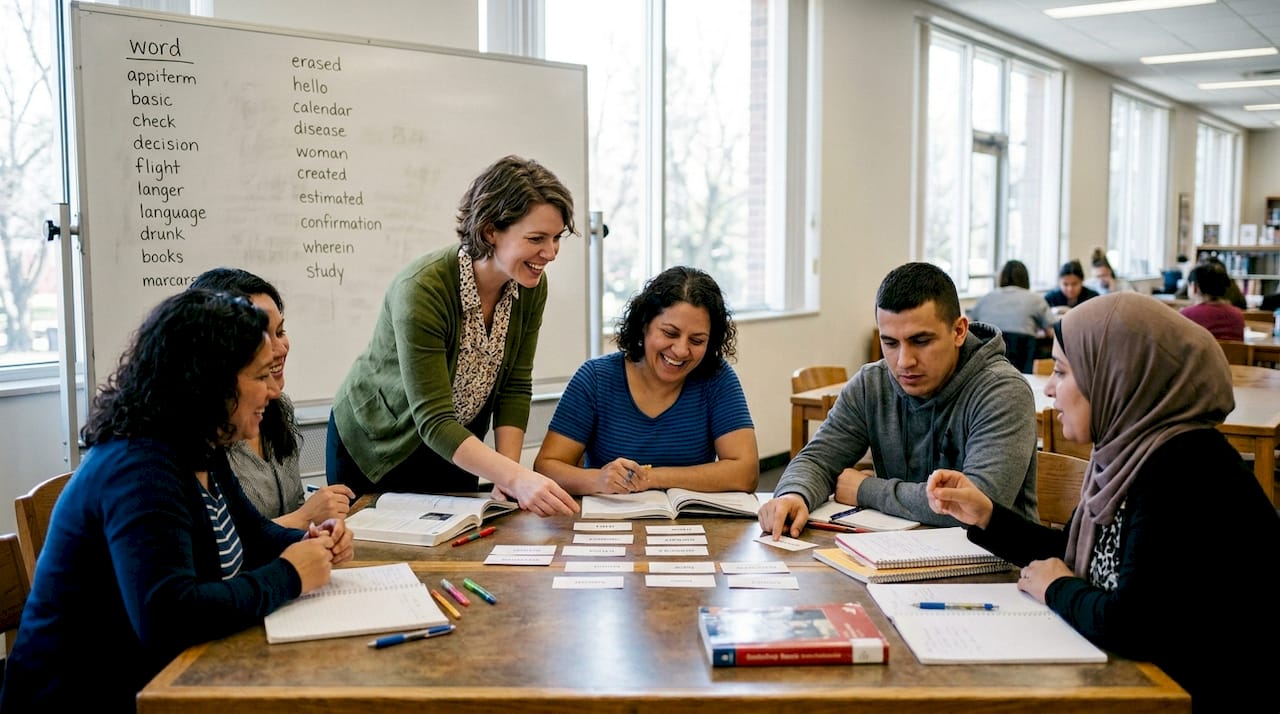
Playing games in the adult classroom is a powerful strategy to reduce stress, increase information retention, and foster a collaborative community. Adult learners often experience heightened anxiety when returning to education; structured play breaks the ice and helps them transition from a long day at the office to an active learning mindset.

Top Game Categories for Adult Learners

  • Community Building & Ice Breakers: These activities lower barriers and help adult students quickly build trust and relational security
  • Vocabulary & Language Games: Classic mechanics games make the repetition of difficult terminology or language learning highly engaging
  • Problem-Solving & Roleplay: Simulations and inductive logic games allow adults to apply theoretical concepts to real-world scenarios without the fear of real-world failure

Best Practices for Implementation:

  • Assess the Room: Always determine your pedagogical or training goals before picking a game
  • Create a Safe Space: Emphasize that the game is a low-risk environment designed for trial-and-error, not performance
  • Gather Feedback: Ask students how they felt about the activity to fine-tune your approach for different learner types

Questions to Ask: - to tailor games to your specific curriculum

  1. What subject or topic are you teaching?
  2. How many students are in your class?
  3. What is the primary learning objective for this specific lesson?

Game Descriptions and Resources

Some games that instructors and CAFE staff have played and resources for each.

Who doesn’t love a good game of Bingo? Take 25 questions and their associated answers. Organize the correct answers options into a 5 x 5 grid. Print the questions and then have students mark off the answer choice that correctly corresponds to each question on their Bingo board (I call my board PHYS-O for physics). This format supports students who feel overwhelmed by even two choices while still reinforcing the content and organization of content.

  • This can serve as a review of vocabulary. It can encourage students to study more. ​
  • Every student has a Bingo card. The instructor selects a term and defines it to the students.​
  • If the student knows the term and has it on their card, they can mark it off. ​

"I did the Social Psychology Bingo in class today, and it was great!  The students were engaged and seemed to really like it. Some comments were that it made them think, and it was a good review.  Another student said it made him realize how much he needs to study. I would recommend it.  It took about 20 minutes for someone to get a Bingo." - Dr. Merilee Krueger

Building Your Cards in Excel

Download this template - Bingo Cards Template

Family Feud is a game show where two teams of five "family" members compete to guess the most popular answers to survey questions previously asked to 100 people. The objective is to reach a set number of points to advance to the "Fast Money" bonus round.

Resources:

Family Feud Instructions

Family Feud PowerPoint Game Summary

Jeopardy! is a trivia game where three contestants compete across three rounds: the Jeopardy! round, Double Jeopardy!, and Final Jeopardy! Contestants are given clues phrased as answers and must buzz in to respond in the form of a question (e.g., "Who is..." or "What is...").

Resources:

Jeopardy Instructions

Jeopardy PowerPoint Game Summary

Taboo is a popular word-guessing and party game. The objective is for a clue-giver to get their teammates to guess a specific "Target Word" within a time limit. The catch? The clue-giver is forbidden from saying the word itself or a list of specific related "Taboo" words.

Incorporates competition, teamwork, and rapid recall; this Active Learning technique promotes learning and student engagement.

  • Can be used for: ​
  • Review sessions before exams  ​
  • Reinforcing key terminology   ​
  • Checking understanding

Core Gameplay & Rules - Downloadable Version of the Rules

  • The Clue: Players take turns giving verbal hints, such as synonyms or descriptive phrases, to guide their team to the target word.
  • Forbidden Words: Each card features 5 "Taboo" words that cannot be spoken, preventing the use of the most obvious descriptors.
  • The Buzzer: The opposing team monitors the clue-giver. If a forbidden word, rhyming word, or part of the target word is used, an opposing player hits a buzzer/squeaker. This voids the card and costs a point.
  • Gestures & Sounds: Acting out the word, making sound effects, or using physical gestures is strictly prohibited.

Purpose: Team building for long-term small groups in your class, and to engage students’ curiosity about the field  

Set up: Have them sit in their small groups and have a set of numerical questions

 Ask a series of quantitative questions remotely related to the course topic or S&T. Have them agree on an estimate in their team. Then have each team share their answers, and the instructor writes them down on the board in order (lowest to highest). The instructor adds “zero” to the top of the list. Then the small groups pick the answer they think is closest without going over (Price Is Right rule). Teams then take turns betting on the answers. More than one team can pick the same answer. The team(s) that gave the correct answer get two points, and any team that picks the correct answer gets one point. Do 5-7 rounds, and the highest score wins.

 Sample questions:

 S&T Related (a source https://data.mst.edu/cds/)

  • In what year did the university’s name change to UM-Rolla (1964)
  • In Fall 2025, how many of our first-time, first-year students were international students (27)
  • Percent of female undergraduates who join sororities (24%)
  • In Fall 2025, the percentage of instructional faculty who are female (29%)
  • What percentage of S&T classes (not including labs or recitations) have over 100 students (3.6%)
  • What percentage of the BS degrees granted were in engineering (excluding CS) in 2025 (64%)
  • Of the out-of-state first-time, first-year students who applied, what percentage came to S&T (8%)

 Course Related:

  • Approximately what percentage of men have some form of color vision deficiency (color blindness) (8%)
  • Tungsten is often considered the strongest natural metal; what is its Mohs hardness (8)
  • What percentage of start-ups fail in the first five years? (80%)

"Would You Rather" is a popular conversation game where players are forced to choose between two difficult, hypothetical, or absurd scenarios. The core challenge is that participants must pick one option and explain their reasoning, making it a great icebreaker or casual party game.

Core Rules

  • Make a Choice: Players must choose one option. Declaring "neither" or "both" is typically against the rules.
  • Justify the Pick: The primary objective is to explain why you made your choice, often leading to humorous or engaging debates.

Common Variations

  • Silly/Fun: Focuses on absurd or comical choices (e.g., "Would you rather have a dragon or a unicorn?").
  • Deep/Philosophical: Tests a person's morals and values (e.g., "Would you rather know the date of your death or the cause of your death?").
  • Adult/Icebreaker: Focuses on workplace, dating, or highly relatable life scenarios to break the ice.

This can be a quick, in-class Think-Pair-Share activity or it can be used as an ice breaker. Be sure the students explain why they made their choice.

Additional Resources

Here are some additional websites with details about more games for the classroom.

Ditch That Textbook.com

Creating Games in Padlet

Well Played Journal: Play Story Press