
Bloom's Taxonomy and Active Learning

Design for Learning Outcomes
Active learning activities align with Bloom’s Taxonomy by shifting students from passive reception to active construction of knowledge, moving from lower-order thinking skills (Remember/Understand) to higher-order skills (Apply, Analyze, Evaluate, Create). Activities like quizzes serve lower levels, while projects and debates foster top-level critical thinking.
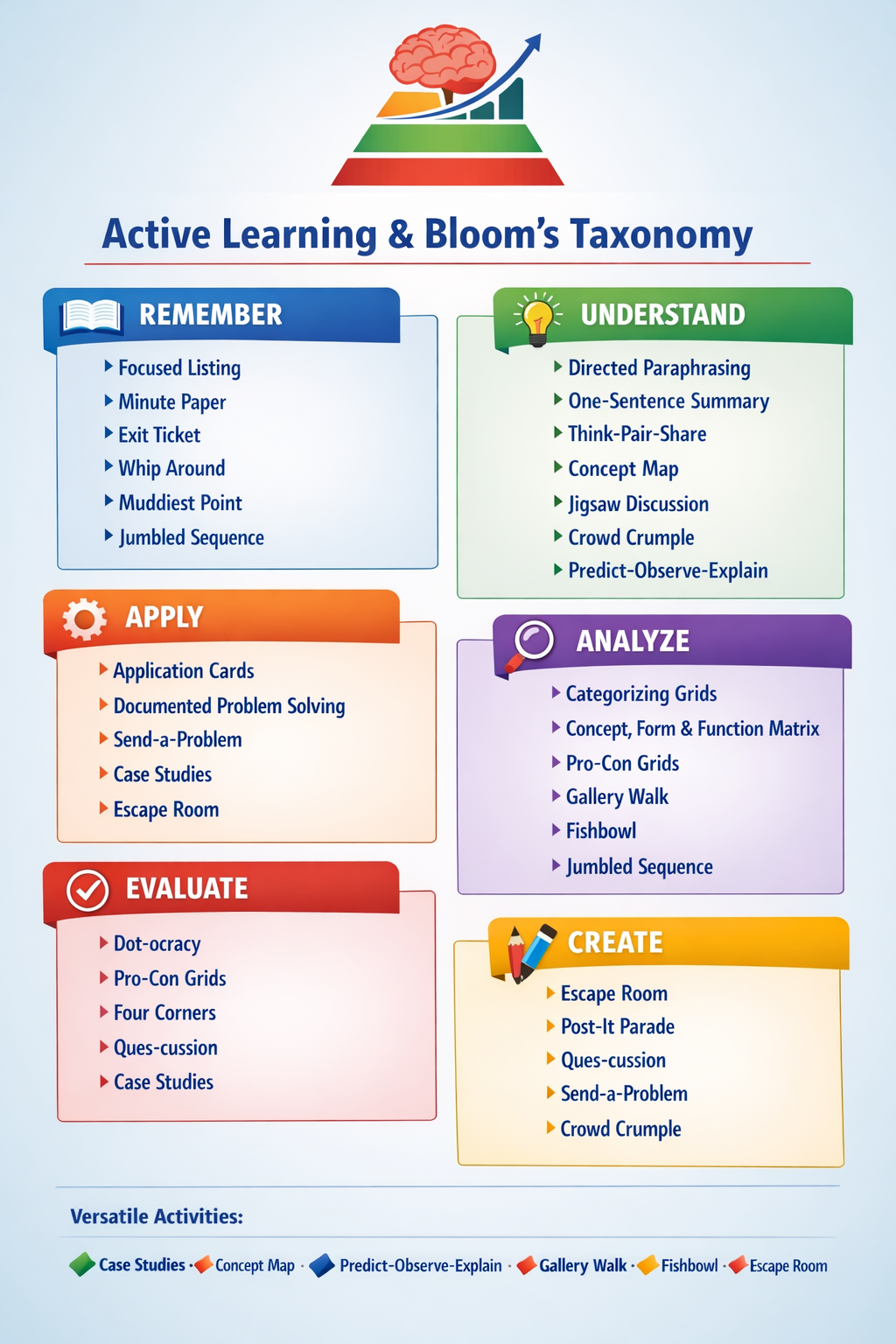
Start with what you want students to think and do. Choose the Bloom's level of learning you want students to engage in. Look for an active learning activity and supporting tool to help you design effective active learning experiences.
Active Learning across Bloom's Levels:
- Remember (Retrieving Knowledge): Activities focus on recall. Examples include using flashcards, audience response systems (clickers), and creating mind maps to recall facts.
- Understand (Explaining Concepts): Activities involve interpretation. Examples include discussing topics in pairs, summarizing readings, creating concept maps, or teaching a concept to peers.
- Apply (Using Knowledge): Activities involve implementing knowledge in new situations. Examples include role-playing, simulations, case studies, and solving practical problems.
- Analyze (Structuring Information): Activities break down information to identify relationships. Examples include comparing/contrasting scenarios, debates, analyzing data sets, and case study analysis.
- Evaluate (Judging Results): Activities require justified decisions. Examples include peer review, debates, critiquing articles, and pros-and-cons grids.
- Create (Generating New Work): Activities involve designing or composing. Examples include developing projects, creating videos, writing proposals, and developing new models or solutions.
Active learning encourages students to not just memorize, but to reflect on how they are learning, pushing them beyond simple memorization into critical analysis.

Follow Center for Advancing Faculty Excellence