
Active Learning
S&T’s Definition of Active Learning
Active learning is learner-centered, not teacher-centered. It requires more from students than just listening. When active learning is used in the classroom, engagement increases, learning improves, and higher-order thinking skills are applied.
Active Learning engages students with the course material through discussions, problem-solving, case studies, role-playing, and other methods. It prepares students for the future by developing their critical thinking, problem-solving, and collaboration skills.

How is Active Learning Different?
In traditional teaching methods such as lecturing, the instructor presents information while students receive it passively. This is teacher-centered and emphasizes the instructor covering the material rather than the students engaging with the material for deeper learning.
What Do Instructors Do Differently?
The instructor guides students, directs questions, provides feedback, and encourages students to take an active role in the learning process. Active learning activities can be done in a few minutes during one class period, a class-long activity, or a flipped class.
It Can Be Done in Small Steps
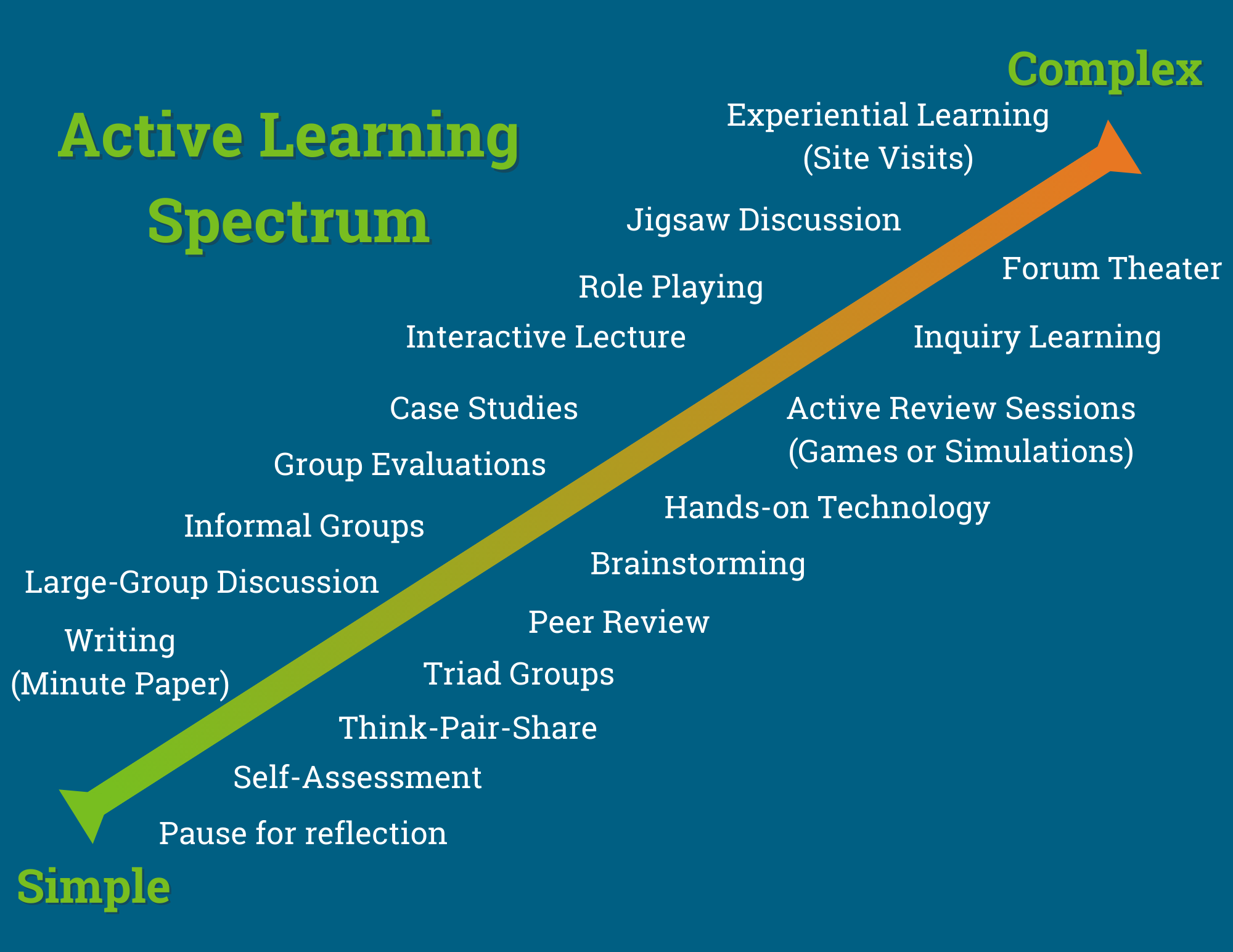
Start by adding a Minute Paper or a Think-Pair-Share learning activity to a lecture. Build up to a full class period of active learning activities such as Case Study, Jigsaw Discussion, and a Gallery Walk. If you would like assistance, reach out to CAFE.
How Do I Start? What are Some Active Learning Activities?
CAFE has developed a booklet featuring a variety of active learning activities you can incorporate into your teaching. To explore these resources, visit our Active Learning Activities webpage.
The activities range from simple to more complex and vary in length from a few minutes to extended time periods. They are designed to be flexible, with options that work at the beginning, middle, or end of class. Several activities are also well-suited for online learning environments.
What Does Active Learning Look Like?
Many assume that active learning requires physical movement within a classroom space. This is not true, but physical movement can play a role in many active learning activities such as labs or on-the-job training. It is important to remember that, as noted above, active learning simply requires learners to meaningfully interact, connect with, and think about information and concepts. An example of active learning that does not require physical movement is responding to a prompt through writing or audio. Other examples of active learning include small-group activities that require students to discuss and debate topics, use classroom clickers or phone apps, and present on relevant topics demonstrating learning.
Can You Identify Examples of Active and Passive Learning?
(source Blended Teaching: A Guide For Applying Flexible Practices During COVID-19, Open Library Pressbook. eCampus - Ontario)
Complete the activity below by determining whether each activity is active or passive. This activity is, itself, an example of active learning as you, the learner, are engaging with the content rather than just reading about it.

Design for Learning Outcomes
Active learning activities align with Bloom’s Taxonomy by shifting students from passive reception to active construction of knowledge, moving from lower-order thinking skills (Remember/Understand) to higher-order skills (Apply, Analyze, Evaluate, Create). Activities like quizzes serve lower levels, while projects and debates foster top-level critical thinking.
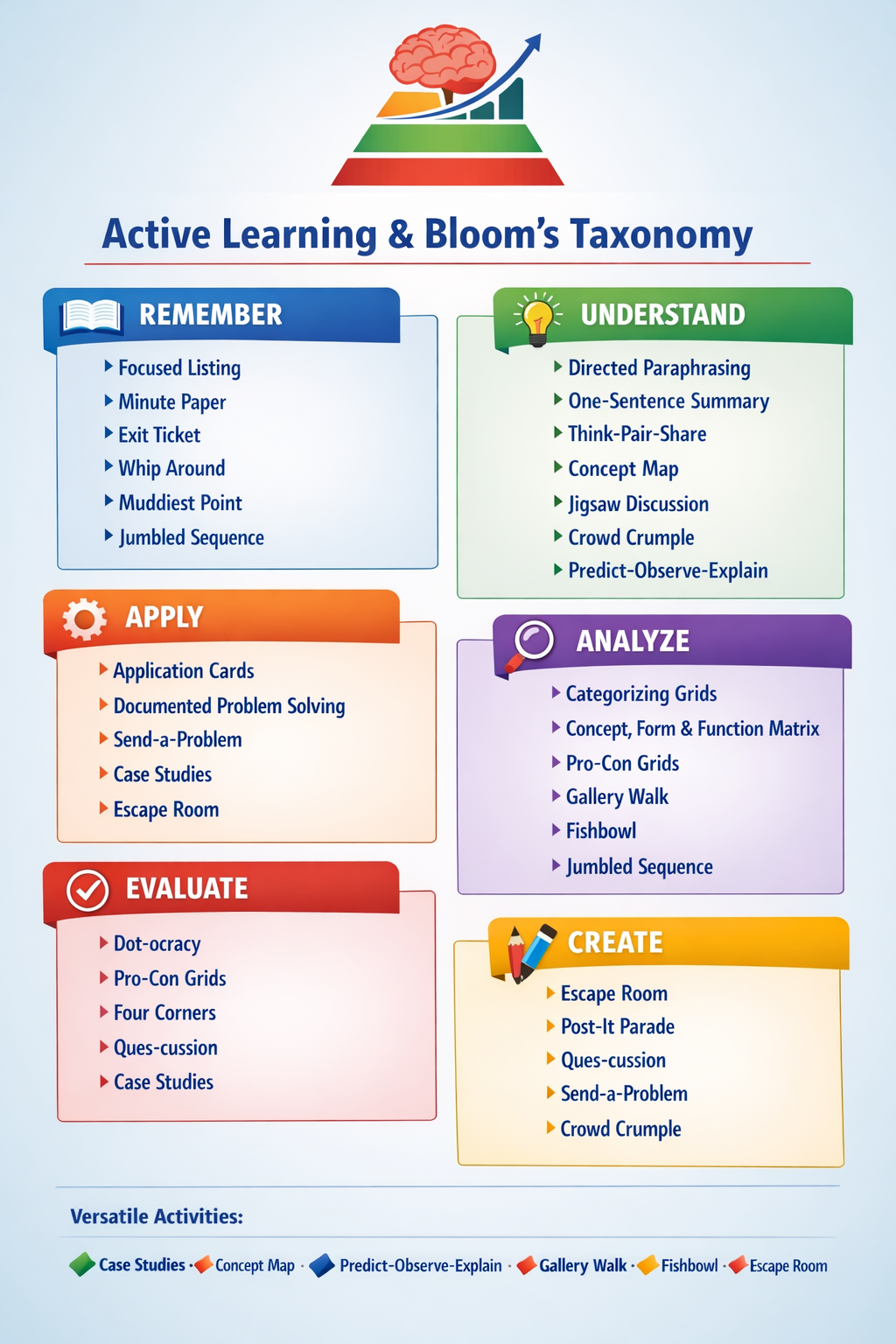
Start with what you want students to think and do. Choose the Bloom's level of learning you want students to engage in. Look for an active learning activity and supporting tool to help you design effective active learning experiences.
Active Learning across Bloom's Levels:
- Remember (Retrieving Knowledge): Activities focus on recall. Examples include using flashcards, audience response systems (clickers), and creating mind maps to recall facts.
- Understand (Explaining Concepts): Activities involve interpretation. Examples include discussing topics in pairs, summarizing readings, creating concept maps, or teaching a concept to peers.
- Apply (Using Knowledge): Activities involve implementing knowledge in new situations. Examples include role-playing, simulations, case studies, and solving practical problems.
- Analyze (Structuring Information): Activities break down information to identify relationships. Examples include comparing/contrasting scenarios, debates, analyzing data sets, and case study analysis.
- Evaluate (Judging Results): Activities require justified decisions. Examples include peer review, debates, critiquing articles, and pros-and-cons grids.
- Create (Generating New Work): Activities involve designing or composing. Examples include developing projects, creating videos, writing proposals, and developing new models or solutions.
Active learning encourages students to not just memorize, but to reflect on how they are learning, pushing them beyond simple memorization into critical analysis.
Follow Center for Advancing Faculty Excellence